
Apocrypha
The Apocrypha are religious texts that are in some versions of the Catholic Bible. Other versions omit them. The word comes from Ancient Greek ἀπόκρυφα (apokrypha). Apocrypha means those that were hidden. Generally, the term is applied to writings that were not part of the canon. There are several reasons why these texts were not included in the canon. The texts might only have been known to few people, or they might have been left out because their content does not fit well into that of the other books of the Bible. Some of the apocrypha were written at a later date, and were therefore not included.
The Authorized King James Version called these books ‘Apocrypha’. It separated them, because the Bible said so in 2 Esdras 14:46, But keep the seventy last, that thou mayest deliver them only to such as be wise among the people: For in them is the spring of understanding, the fountain of wisdom, and the stream of knowledge.
Roman Catholic Bibles have these books in the Old Testament. They do not call them Apocrypha. They call them deuterocanonical, which means that they belong to the second canon. Canon just means an official list of literary works accepted as representing a field. The first list is of books first written in Hebrew. This second list is of books first written in Greek.
Some say
These books were kept in Catholic Bibles because it is believed that the Bible which Jesus read was a Bible that included the books of the "Apocrypha," the deuterocanonical books. It is known that the most popular Bible at the time of Jesus was the Greek Septuagint version - which includes these extra books. That is why early Church fathers quoted from Bibles including these books.
Others say
Christians disagree about the ‘Apocrypha’. Others point out that the ‘Apocrypha’ was in every Christian Bible until 1828. In 1828 these books were taken out of some Bibles. The translators of the King James Bible said that these books were written to prepare the people for Jesus, in the same way as John the Baptist did. They said that the apostles used these books. And modern day members of the Church of Jesus Christ of Latter-Day Saints (sometimes referred to as Mormons) also have hints in the Book of Mormon.
There is no question that these books have always been part of the Bible in Oriental Orthodox Churches, so they were definitely not added in the 1500s. Around the year 80 AD, the Jewish Council (Sanhedrin) decided to cut the books from the Hebrew Bible, but they stayed in the Christian Bible. Then soon after Christianity became the only religion of Roman Empire in the 4th century, the Romans decided to cut out all of the same books that the Sanhedrin had cut out, and they moved some of them to the "apocrypha".
The KJB translators placed the Apocrypha between the Testaments, instead of interspersed in the Old Testament. Why did they do this? These specific 14 Books were known as "Apocrypha" or "hidden" and were part of the Septuagint [70] which was the trusted Scriptures of the 1st Century when Christ was born. Peter Ruckman believed the KJB was inspired, but did err in his assessment of the Apocrypha. He believed it was separated from the other books of the old testament because it wasn't inspired and claimed their were notes from the Translators signifying such. However, there was no "specific note" as Ruckman states, "that it was not the inspired word of God and not considered to be holy scripture." The Apocrypha in the original KJB printed in A.D. 1611 still had chapter and verse divisions, as well as marginal notes. Each page of the Apocrypha was identical to the rest of the Bible with the exception of a double heading labeled “Apocrypha” (meaning "hidden" in Greek) at the top of each page. The last page of the Old Testament had the remark “The end of the Prophets.” The start of the Apocrypha did not have an elaborately illustrated title page as the beginning of the Old and New Testament, but rather a quarter-page heading slightly larger than the start of each Old Testament book signifying that it was part of the old Testament. At the end of the Apocrypha there was simply a line that stated "The end of Apocrypha," not the end of the Old Testament.
Beginning of Apocrypha
Furthermore, no warning was made of the Apocrypha in the preface of the KJB entitled, "The Translators to the Readers." No warning could be locating indicating anywhere in the 1611 Printing that the Apocrypha was not true Scripture.
The index of books in the original 1611 printing did distinguish the Apocrypha, but only as a separated division of the Old Testament. This is because the heading at the top of the index page states “The names and order of all the Bookes of the Olde and New Testament, with the Number of their Chapters.” The books of the Apocrypha have the number of their chapters, and is included under the Old Testament Section of the Table of Both Testaments. The index supports that the Apocrypha is a section of the Old Testament (also remember that the end of Malachi had a note stating it was the “end of the Prophets,” not the end of the Old Testament).
in Summary: Regarding the inspiration of the Apocrypha and the historical use and importance of IT in the eyes of the King and his Translators; Peter Ruckman is only right to the extent that the 1611 Bible does indeed separate the Apocrypha from the Testaments, made it clear where it started and ended, and listed the books it was composed of in the index.
However, to state that the translators made a specific note by the Apocrypha “that it was not inspired” is simply not true. It was also not true for Ruckman to claim that “the Apocrypha was placed between the testaments with a note that it was not the Scripture.” No note could be found anywhere in the 1611 edition in which the translators affirmed the Apocrypha was not Scripture. Those who are familiar with the Scriptures would naturally be able to recognize that Apocryphal sections were treated as Scripture, and thus logically and reasonably conclude all portions with chapter and verse numberings to be Scripture as presented in the 1611 edition.
THEREFORE, the KJV translators took the Apocrypha more seriously than much, if not most of the professing believers of Christ in these modern times. In addition to its inclusion between the Testaments, a schedule of Scripture readings for morning and evening prayer included passages from the Apocrypha, and the 1611 edition also had some marginal cross-references to books of the Apocrypha in the Old and New Testament. All this historical and logical evidence clearly refutes the erroneous statements, notes and claims against the convictions and actions of the King and his translators regarding the inspiration of the Apocrypha.
NEED MORE PROOF?

The Deuterocanonical Books In The Original 1611 Holy Bible Authorized by the kingly House of David.
In 1615, The Anglican Archbishop [George] Abbott, a High Commission Court member and one of the original translator of the now called the King James Bible, "forbade anyone to issue a Bible without the Apocrypha on pain of one year's imprisonment"
(Moorman, Forever Settled, p. 183).
WERE THE "APOCRYPHA" BOOKS REALLY IN THE ORIGINAL AV1611 KJV?
The truth is the original 1611 Holy Bible authorized by King James contained the Deuterocanonical (Secondary) books. Just as these books the Protestants call the "Apocrypha" Books were in Martin Luther's Translation and all of the Earlier Protestant English Translations of the Bible which Predated the 1611 KJB. This should not come as a surprise when one considers that right inside the front cover the KJB says That it was:
Newly Translated Out Of The Original Tongues and with the former translations diligently compared and revised.
Thus, we can safely say the authorized bible by the Kingly house of David, by King James of England. The "version" of the incorruptible Bible that most Protestants use today omits These 7 Books ( or counted as 14 Books when each section is counted as one.) [There are 155,683 words in over 5,700 verses in 168 Chapters in the "Apocrypha" as divided in the 1611 King James Bible] of scripture. Verses which were originally contained in The Holy Bible of the King James and also in ALL of the other previous Protestant English translations of the Bible prior to his clearing of the word.
Were not the "Apocrypha" Books a part of the Septuagint version [The LXX]? Did not the LXX play an important part in the creation of the King's authorised Bible?
The answer to both of these questions is "YES". The translators chose to base the structure and order of their Canon on the Septuagint. The KJV translators themselves not only believe in the existence of the Septuagint, but also believed that God
caused the LXX to be created, that Christ the Apostles used the Septuagint, and that the LXX, was the very word of God.
"This is the translation of the Seventie Interpreters, commonly so called, which prepared the way for our Saviour among the Gentiles by written preaching, as Saint John Baptist did among the Jewes by vocall." (from the Translators' Preface to the 1611 KJB).
To start with we Know King James own Position on the "Apocrypha" Books:
"As for the Scriptures, no man doubteth, I will believe them; but even for the Apocrypha, I hold them in the same account that the ancients did: they are still printed and bound with our Bibles, and publicly read in our Churches; I reverence them as the writings of holy and good men:" ["The Church History Of Britain" by Thomas Fuller, Oxford, M.DCCC.XLV].
We Know That King James intended to have the "Apocrypha" in his Bible, he set up the "Translation" Committee in a very specific structure it was composed of six panels of translators (47 men in all), two panels met respectively in Westminster, Cambridge and Oxford. Three panels were responsible for the Old Testament, two for the New Testament, and one One of the Cambridge Companies specifically for the "Apocrypha" Books, this last group composed of seven members was led by Dr. Bois. although the King nominated the translators to the number of fifty-four actually only 47 actually took part in the work which, however--officially at least--they were in no hurry to begin; for, although named in 1604 and with all the preliminaries arranged before the end of that year, they did not begin their work till 1607.
When the translation and multiple revisions were done and approved by Bishop Belson, both he and Miles Smith Delivered a hand written copy of the Bible [including the "Apocrypha"] to Robert Baker, the King’s Printer [who up until 1629 had exclusive Printing rights to this Bible], whose shop was in the Churchyard of St Paul’s. There were three separate printings of the King’s Bible in the first year [1611] and a total fifteen editions [often between five hundred and a thousand copies each printing] between 1611-1614..
we know for a fact, that the translators held these books as sacred and wish them to be part of there Bible, by the measures they took to keep part of the KJV.
"One of the participating Archbishops [George Abbott], issued an order in 1615, forbidding on penalty of a year's imprisonment the sale of any Bible omitting them" (The Dartmouth Bible, A edition of the KJV, (C) 1961 p. 735).
This pages are from the 1612 printing of the King James Version "Apocrypha" second book of the Maccabees. This sheet is of chapter XII , it is in this chapter that we find the famous "praying for the Dead" verse.
This page a leaf is part of a personal collection from the 1612 printing by Robert Barker, the King’s Printer, London of the King James Version.
This next one is an original leaf (page) from the King James Bible. This is the Table of Contents. Please note that it list all the books of the old Testament, the Apocrypha and the new Testament. This leaf is from the original first printed of the King James Version, the Great "HE" Bible. It was printed by Robert Barker at London, England in 1611, Measuring 16 by 10 inches.
Throughout the following centuries we find that in the KJV the Deutero-canonical books would appear and disappear in a whirlwind of apparent confession as the following Link shows. These a just a few (and only jest a few) examples.
WHAT DOES THE TITLE PAGE TELL US?
It is also interesting to note, that the beautify engraved title page which was to the Scriptures Simply say " The Holy Bible, Conteyning the Old testament, and the New" with no designation separating the "Books called Apocrypha" [Even though they were bound in the middle of this section.] from the Old testament. The creators of the 1611 KJV went to great lengths to form a separation between the Old and New testament even placing a special elaborately engraved title page marking the beginning of the New testament. Yet they placed NO SUCH distinction between the end of the Old Testament and the "Apocrypha". Again this show acceptance of these Books as part of the Old Testament.
Another, great example of the acceptance of the "Apocrypha" Books as part of the Old Testament is that as late as 1764 [printed by Joseph Harrop, in Manchester England.] some King James Version were printed containing only the Old Testament and "Apocrypha."
By far most of the editions of the KJV printed between 1611 and 1890 contained the "Apocrypha" books bound between the New and Old Testaments. [here are a few examples of the tables of contents from different editions of the KJV 1614, 1615, 1625 Binding, 1625 image, 1625, 1670, 1674, 1791, 1824, 1846, 1873, 1877]
Some Protestants will try to argue;
Doesn't the 1611 introduce these Books as Apocrypha , which means "spurious,".
First the word Apocrypha simply means "Hidden". We must also note that the 1611 introduces these Books as being "called Apocrypha." NOT "As being Apocrypha" there is a fine difference between the two.
Another way we know that the "Apocrypha" Books were held in high regard in the early KJV's is the way the printers decorated them with ornate woodcuts.
The 1625 King James Version Printed by Richard Norton and John Bill The "printers to the Kings moft excellent Majestie". This printing has become fondly know among collectors a the "Last Edition" because of the year of its Printing. This was The LAST edition published During the reign of King James the first of England.
WHAT DO THE MARGIN NOTES AND CROSS-REFERENCES TELL US?
Many Protestants will try to argue;
"Sure thay were there, but thay were never held by the translators as authoritative or Scriptural."
We find the "Apocrypha" cross-referenced to the New and Old Testaments.
If this were true, than may I ask, why would any credible scholar cross-reference Sacred Scripture to an "uninspired", "unauthoritative", and "unscriptural" book? The fact is they wouldn't, yet in the Original 1611 King James Version we find over 840 marginal cross-references books of the "Apocrypha" (the Deuterocanonical books) to the "ligament" Books allow me to Show just a few.
This leaf is from the 1612 printing [by Robert Barker, the King’s Printer, London] of the King James Version "Apocrypha" book of Ecclesesiasticus. The marginal notes show the translators cross-referenced these "Apocrypha" verses thirteen times to the Old New and testament: This leaf is in a "Roman type print".

OLD TESTAMENT
11:1 was cross-referenced to Gen. 40:40 and Dan.6:3
11:6 was cross-referenced to 1 King 15:18
11:8 was cross-referenced to Prov. 8:13
11:11 was cross-referenced to Prov. 10:13
11:12 was cross-referenced to Job. 1:12 and Ezek. 28:4
11:23 was cross-referenced to Mal. 3:14
NEW TESTAMENT
11:4 was cross-referenced to Acts. 12:21
11:11 was cross-referenced to Mat. 19:12 and I Tim. 6:9
11:19 was cross-referenced to Luke 12:19
11:20 was cross-referenced to Mat. 10:22
We Must point out that not only did the the 1611 came complete with Apocrypha and Margin notes, but that these "Apocrypha books" and these same "Margin notes" were very much a part of the KJV for over a hundred years. History of the so called "Apocryphal" Books in the King James' Bible may be corrupt so you don't read them!
This next Leaf is also part of a private collection from the 1625 King James Version Printed by Richard Norton and John Bill The "printers to the Kings moft excellent Majestie". This printing has become fondly know among collectors as the "Last Edition" because of the year of its Printing. This was The LAST edition published During the reign of King James the first of England. this leaf is arraigned in double columns in "Gothic print type".
OLD TESTAMENT
1:1 was cross-referenced to Ezra. 7:1
1:4 was cross-referenced to Isa. 58:1
1:10 was cross-referenced to Exod. 14:28
1:11 was cross-referenced to Num. 21:24
1:11 was cross-referenced to Josh. 8:12
1:13 was cross-referenced to Exod. 14:29
1:13 was cross-referenced to Exod. 3:10
1:13 was cross-referenced to Exod. 4:14
1:14 was cross-referenced to Exod. 13:21
1:15 was cross-referenced to Exod. 16:13
1:15 was cross-referenced to Psalm 104:40
1:17 was cross-referenced to Num. 14:3
1:20 was cross-referenced to Num. 20:11
1:21 was cross-referenced to Isa. 5:4
1:21 was cross-referenced to Exod. 15:23
1:24 was cross-referenced to Exod. 32:8
1:26 was cross-referenced to Isa. 1:15
1:31 was cross-referenced to Isa. 1:13

NEW TESTAMENT
1:30 was cross-referenced to Mat. 23:37
We must remember that these "Cross references of the Scriptures" was one of the Fifteen general rules were set forth in advance
By King James himself for the guidance of his translators of his authorized translation of the Bible:
"7. Such Quotations of Places to be marginally set down as shall serve for the fit Reference of one Scripture to another."
[As found in "The Church History Of Britain" by Thomas Fuller, Oxford, M.DCCC.XLV]
We find the New and Old Testaments cross-referenced to the "Apocrypha".
We even find them even cross-referencing the Old and New Testaments to the "Apocrypha" books. The total number of references in the margins in the Old and New Testaments to the "Apocrypha" books of the King James Bible as printed in 1611 is 113.
Of this number, 102 are in the Old Testament, and 11 in the New. The New Testament passages with references to the
Apocrypha are as follows:
Mat 6:7 Ecclesiasticus 7:14
Mat 27:43 Wisdom 2:15-16
Luke 6:31 Tobit 4:15
Luke 14:13 Tobit 4:7
John 10:22 1 Maccabees 4:59
Rom 9:21 Wisdom 15:7
Rom 11:34 Wisdom 9:13
2 Cor 9:7 Ecclesiasticus 35:9
Heb 1:3 Wisdom 7:26
Heb 11:35 2 Maccabees 7:7
The above references are taken from the 1625 King James Version, Printed by Bonham Norton and John Bill The "printers to the Kings moft excellent Majestie". This Bible is part of my collection.
WERE NOT THESE BOOK PLACED IN THIS BIBLE FOR HISTORICAL PURPOSES?
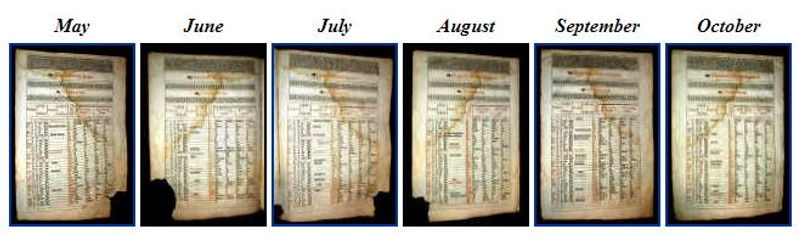
The original 1611 KJV had a calendar for each month of the year. Bellow are scans of the 1613 KJV calendars for the months of:
All of these leafs were printed by Robert Barker at London, England in 1613. The page size is A HUGE 11" X 16" these are Original leafs from the true Second Folio of the King James Bible. Black and red Letter English language text arraigned in double columns in "Gothic print type". The following links at to scans of the remaining months, these scans are from the Nelson reprint of the KJV:
These calendars contained [shown in the scan above] contained such things as a schedule of Scripture readings for morning and evening prayer which includes passages from the "Apocrypha":
2 Esdras May 27-29;
Judith, Oct. 6-13;
Wisdom, Jan. 25; Feb.3; Feb. 24; Oct. 14-17; Nov. 1;
Ecclesiasticus; July 25; Oct. 18;
Among the Pages of the 1611 KJV was a Chart showing the scriptural Lessons to be taught at the different saint's holy days. It included lessons from the "apocrypha" Books. The above scan is from a facsimile of the first impression the original 1611 edition of The King James Bible was produced in 1961 for the World Publishing Company
The 1611 KJV encourages rather than discourages the use of the Apocrypha in devotional reading and public worship, which is strange if the "Apocrypha" is not considered in some way inspired and authoritative Scripture. Clearly, the original translators of the 1611 King James Version held the Deuterocanonical books as authoritative or Scriptural, and worthy of public prayer and worship. It is also important to note the occasions of the use of these "Apocrypha" books in the calendars.
We observe the creators of the Kings Bible chose to use the book of "Ecclesiasticus" and "Wisedome" for Public prayer on the special holy days and for many of the days in honor of the Apostles of Christ, some examples are:
As we can see above also found in these calendars, are designated saints days' (Sept. 30, St. Jerome, [The creator of the Catholic Latin Vulgate]; Oct. 18, Luke the Evangelist; Oct. 28, Simon and Jude); a list of designated fast days (Oct. 27 and 31); The significance of this is that "saints' days" and "fast days" are considered "popish" and "Romanist" by Most Protestants today, yet there they are listed in the 1611 KJV
These calendars also contained a notation about which sign of the zodiac the sun is in that month (Oct. 12, "Sol in Scorpio"); The Significance of this is that most Protestants today consider astrology "New Age" and "of the devil," yet there it is in The early printing of the King James Version.
THE "APOCRYPHA" WRITINGS IN SONG FORM, FOR USE IN THE WORSHIP SERVICES:
The Song of the iii Children, from a 1615 King James Version. This leaf was printed by Robert Barker at London, England.
Not only does the 1611 KJV promote the use of these writings for public teaching, It actually had printed among its pages some of the "Apocrypha" books in to song form, to be sung during the public worship services. We must remember that the original 1611 KJV was a pulpit Bible, it was printed with the intention to be used by the Church of England . The 1611 edition (like many subsequent editions that would follow it) contained the Anglican Psalter or Psalms of David (by Sternhold and Hopkins), The title page of this Psalter reads:
"Set forth allowed to be Sung in all Churches, of all the People together, before and after Morning and Evening Prayer, and also before and after Sermons; and moreover in private houses for their godly Solace and Comfort, laying apart all un-godly songs and Ballads, which tends only to the nourishing of Vice, and corrupting of Youth."
Among the pages of this Psalter is the " Song of the iii Children" , it is a musical rendition of the "Apocrypha" writing by the same name (Part of the book of Daniel Chapter three in the Catholic Bible). its The 1611's Psalter version of this writing is complete with musical notes, ready to be sung in public worship.

Jan. 25 is the holy-day in honor of the "Conuerf [conversion] of Paul" the book of "Wisedome" was chosen
Feb. 2 is the holy-day in honor of "Purification of Mary" the book of "Wisedome" was chosen
Feb. 24 is the holy-day in honor of "S. Matthias" the book of "Ecclesiasticus" was chosen
Jun. 29 is the holy-day in honor of "S. Peter Apostle" the book of "Ecclesiasticus" was chosen
July 25 is the holy-day in honor of "S. James Apostle" the book of "Ecclesiasticus" was chosen
Aug. 24 is the holy-day in honor of "S. Barthol. Apostle" the book of "Wisedome" was chosen
Oct. 18 is the holy-day in honor of "S. Luke. Apostle" the book of "Wisedome" was chosen
Nov. 1 is the holy-day in honor of "All Saints" the book of "Wisedome" was chosen